Austin Center for Design | capstone project
Kindred
New parents tend to prepare for the birth rather than what comes after; Kindred helps them line up real support before the baby arrives. We designed and validated through 20 interviews, 200+ concepts, and a field experiment ran entirely by hand.
My role
Co-founder: research, strategy, and all UI design
Timeline
16 weeks
Team
2 designers: my co-founder and me
Methods
Interviews, synthesis, concept testing, Wizard of Oz field experiment

20 interviews
20 interviews
Across the postpartum ecosystem, including parents, partners, and doulas.
200 concepts
200 concepts
Generated before narrowing to one testable idea.
3 days
3 days
Field experiment run by hand before any high-fidelity design.
20 interviews
Across the postpartum ecosystem, including parents, partners, and doulas.
200 concepts
Generated before narrowing to one testable idea.
3 days
Field experiment run by hand before any high-fidelity design.
The stakes
Everyone prepares for the birth. Almost no one prepares for what comes after.
The first three months after birth are known as the fourth trimester, and they arrive like a cliff. Overnight, first-time parents face decisions they have never made before, on no sleep and with a body still in recovery. The pattern in almost every story we heard is that first-time birthing parents felt: overwhelmed, exhausted, and isolated. We spent 16 weeks asking whether design could soften that landing.

The learning curve we heard in interviews: steady through pregnancy, chaotic after birth
The stakes
Everyone prepares for the birth. Almost no one prepares for what comes after.
The first three months after birth are known as the fourth trimester, and they arrive like a cliff. Overnight, first-time parents face decisions they have never made before, on no sleep and with a body still in recovery. The pattern in almost every story we heard is that first-time birthing parents felt: overwhelmed, exhausted, and isolated. We spent 16 weeks asking whether design could soften that landing.
The learning curve we heard in interviews: steady through pregnancy, chaotic after birth
the Process
From 20 conversations to one tested idea
1
20 conversations
We interviewed 20 people: birthing parents, their partners, and the professionals who support them, including postpartum doulas. Talking to the whole ecosystem rather than just parents is what exposed the real problem—parents were not only under-supported, they were struggling to ask for help.
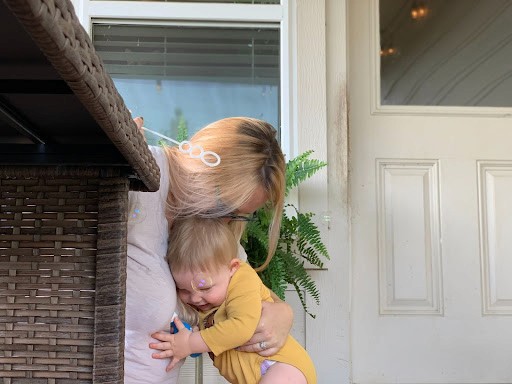

Interviews met parents where postpartum actually happens
“If I ask for help, I’m being vulnerable. And if they don’t help me, it’s like they’re letting me down — I don’t want to be let down.”
Maddie, 4 months postpartum
“People spend so much time focusing on the wedding, and then don’t think about the marriage. A lot of families are almost tunnel-visioned on the birth.”
Jessie, Austin postpartum doula
2
Choosing one problem out of many
Research surfaced more problems than one capstone could touch. We plotted them on a 2x2—how much an issue hurt families against how much two designers could realistically move it—and committed to the intersection: parents feel deprioritized once the baby arrives, and asking for help feels too risky to do.

Every problem we heard, plotted by pain and our ability to impact it
3
Three core insights
Synthesis landed on three core insights, each paired with an opportunity we could design for.
Insight 1
Parents prepare for the baby—not for their own recovery and care.
How might we
…encourage birthing parents to prioritize their postpartum care and recovery?
Insight 2
Asking for help feels especially risky for birthing parents because they’re putting themselves in a position to be judged, disappointed, or rejected when they’re already feeling vulnerable.
How might we
…highlight the benefits of connecting with sources of support while sharing the potential risks of not asking for help?
Insight 3
Friends and family want to be supportive, but they don’t always know how or when to be most helpful.
How might we
…facilitate communication and coordination between birthing parents and their support network?
4
200 ideas, narrowed by evidence
We generated over 200 concepts, then storyboard-tested the strongest with parents. The winner wasn’t the cleverest idea, but the one that made coordinating help easier. Existing products either weren’t built for birthing parents or didn’t touch coordination at all, which told us we were standing in open space. Four principles from that testing guided everything after.
200+ ideas from divergent brainstorming
A few storyboarded and tested
One concept
Design principles from testing
Favor face-to-face help
Lean on community
Celebrate the parents
Offload mental work

“This idea really resonated, because my brother’s idea of helping was holding the baby for 10 minutes. And I remember thinking how it’d be more helpful if he just walked the dog.”
Jen (1 year postpartum), on the concept we moved forward
5
Testing the riskiest assumption by hand
Before any high-fidelity design, we isolated the assumption the whole product depended on and tested it before building anything. In a Wizard-of-Oz experiment, we acted as the app ourselves: over Google Voice, participants received one small assignment a day for three days and sent back a voice memo each night.
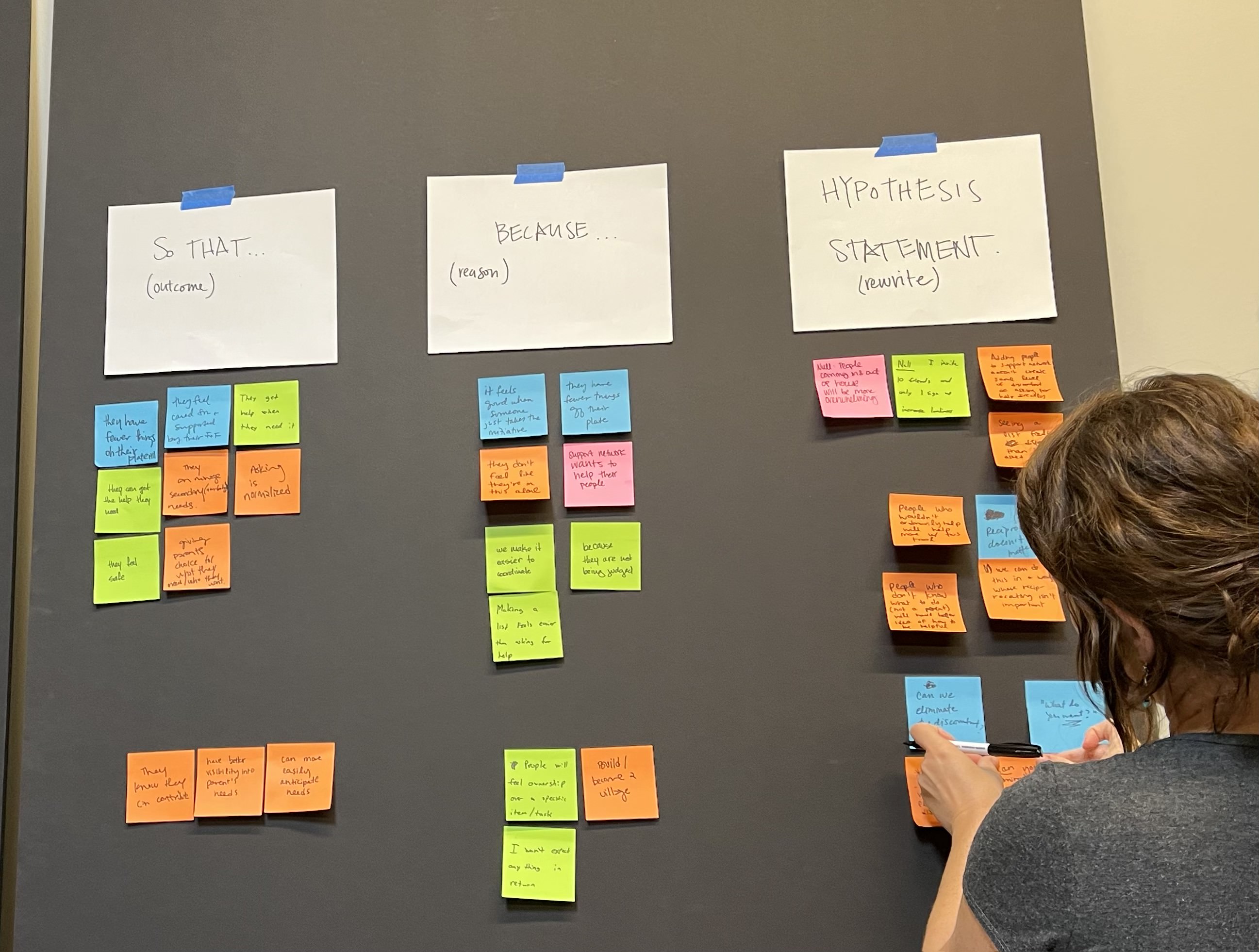
Outcome, reason, statement: isolating the assumption on paper first
The fundamental hypothesis
If expectant parents get bite-sized information about the fourth trimester, they will take action towards preparing for postpartum, including reaching out to someone in their support network.
Day 1: Learn
A short read on the fourth trimester re: what actually changes, and when.
Day 2: Reflect
Fill-in-the-blank scenarios: who would you lean on in each situation?
Day 3: Act
Personalize a template message and send it to someone in your support network.

Daily assignments and voice memo check-ins, run via Google Voice
Three participants can only tell you so much, but the pattern became clear that given one small, concrete prompt a day, people actually reached out for help. That became the backbone of Kindred; learn, figure out who to ask, then ask.
the Process
From 20 conversations to one tested idea
1
20 conversations
We interviewed 20 people: birthing parents, their partners, and the professionals who support them, including postpartum doulas. Talking to the whole ecosystem rather than just parents is what exposed the real problem—parents were not only under-supported, they were struggling to ask for help.
Interviews met parents where postpartum actually happens
“If I ask for help, I’m being vulnerable. And if they don’t help me, it’s like they’re letting me down — I don’t want to be let down.”
Maddie, 4 months postpartum
“People spend so much time focusing on the wedding, and then don’t think about the marriage. A lot of families are almost tunnel-visioned on the birth.”
Jessie, Austin postpartum doula
2
Choosing one problem out of many
Research surfaced more problems than one capstone could touch. We plotted them on a 2x2—how much an issue hurt families against how much two designers could realistically move it—and committed to the intersection: parents feel deprioritized once the baby arrives, and asking for help feels too risky to do.
Every problem we heard, plotted by pain and our ability to impact it
3
Three core insights
Synthesis landed on three core insights, each paired with an opportunity we could design for.
Insight 1
Parents prepare for the baby—not for their own recovery and care.
How might we
…encourage birthing parents to prioritize their postpartum care and recovery?
Insight 2
Asking for help feels especially risky for birthing parents because they’re putting themselves in a position to be judged, disappointed, or rejected when they’re already feeling vulnerable.
How might we
…highlight the benefits of connecting with sources of support while sharing the potential risks of not asking for help?
Insight 3
Friends and family want to be supportive, but they don’t always know how or when to be most helpful.
How might we
…facilitate communication and coordination between birthing parents and their support network?
4
200 ideas, narrowed by evidence
We generated over 200 concepts, then storyboard-tested the strongest with parents. The winner wasn’t the cleverest idea, but the one that made coordinating help easier. Existing products either weren’t built for birthing parents or didn’t touch coordination at all, which told us we were standing in open space. Four principles from that testing guided everything after.
200+ ideas from divergent brainstorming
A few storyboarded and tested
One concept
Design principles from testing
Favor face-to-face help
Lean on community
Celebrate the parents
Offload mental work
“This idea really resonated, because my brother’s idea of helping was holding the baby for 10 minutes. And I remember thinking how it’d be more helpful if he just walked the dog.”
Jen (1 year postpartum), on the concept we moved forward
5
Testing the riskiest assumption by hand
Before any high-fidelity design, we isolated the assumption the whole product depended on and tested it before building anything. In a Wizard-of-Oz experiment, we acted as the app ourselves: over Google Voice, participants received one small assignment a day for three days and sent back a voice memo each night.
Outcome, reason, statement: isolating the assumption on paper first
The fundamental hypothesis
If expectant parents get bite-sized information about the fourth trimester, they will take action towards preparing for postpartum, including reaching out to someone in their support network.
Day 1: Learn
A short read on the fourth trimester re: what actually changes, and when.
Day 2: Reflect
Fill-in-the-blank scenarios: who would you lean on in each situation?
Day 3: Act
Personalize a template message and send it to someone in your support network.
Daily assignments and voice memo check-ins, run via Google Voice
Three participants can only tell you so much, but the pattern became clear that given one small, concrete prompt a day, people actually reached out for help. That became the backbone of Kindred; learn, figure out who to ask, then ask.
The product
Prepare in prepartum. Lean on your village in postpartum.
Kindred has parents prepare during pregnancy, so that once the baby arrives, coordinating help from their village is one tap instead of one more thing on their mental load. We spent most of the 16 weeks getting the idea right, and the screens came together fast once it was. Each feature below traces straight back to an insight or an experiment result.
Bite-sized preparation
Small, manageable steps to get ready for postpartum; clear information about the fourth trimester without another parenting textbook.
Why this: the clearest signal from the three-day test. Small, digestible steps were what got expectant parents engaging with postpartum prep at all.

Know who to lean on
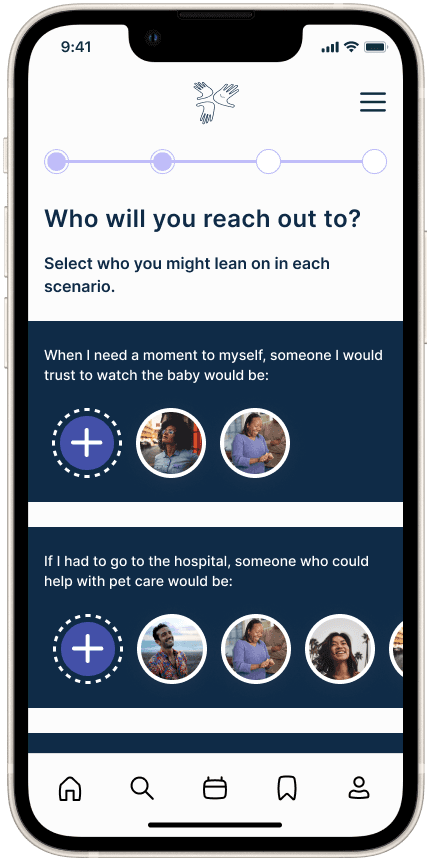
Scenario prompts help parents figure out who in their life fits which kind of support (before they need it).
Why this: Day 2 of the experiment. Scenario prompts turned an abstract support network into named people.
Easier asks
Template messages take the awkwardness out of reaching out. Personalize, send, done.
Why this: Insight 2 said asking feels risky, and Day 3 showed the fix. Participants given a template to personalize actually reached out.

Shared visibility for the village
A shared calendar where support people opt into real, scheduled acts of care—from meals to dog walks—with auto-filled requests for parents who aren’t sure what to ask for.
Why this: Insight 3, plus concept testing. The village wants to help but does not know how or when, and easier coordination was the idea that resonated hardest.

The product
Prepare in prepartum. Lean on your village in postpartum.
Kindred has parents prepare during pregnancy, so that once the baby arrives, coordinating help from their village is one tap instead of one more thing on their mental load. We spent most of the 16 weeks getting the idea right, and the screens came together fast once it was. Each feature below traces straight back to an insight or an experiment result.
Bite-sized preparation
Small, manageable steps to get ready for postpartum; clear information about the fourth trimester without another parenting textbook.
Why this: the clearest signal from the three-day test. Small, digestible steps were what got expectant parents engaging with postpartum prep at all.
Know who to lean on
Scenario prompts help parents figure out who in their life fits which kind of support (before they need it).
Why this: Day 2 of the experiment. Scenario prompts turned an abstract support network into named people.
Easier asks
Template messages take the awkwardness out of reaching out. Personalize, send, done.
Why this: Insight 2 said asking feels risky, and Day 3 showed the fix. Participants given a template to personalize actually reached out.
Shared visibility for the village
A shared calendar where support people opt into real, scheduled acts of care—from meals to dog walks—with auto-filled requests for parents who aren’t sure what to ask for.
Why this: Insight 3, plus concept testing. The village wants to help but does not know how or when, and easier coordination was the idea that resonated hardest.
Where it landed
A capstone that ended with investors asking for more
We closed the 16 weeks by presenting Kindred to a public audience of designers, founders, and guests. Afterward, we were approached about taking the concept further—for a student project built on primary research, that was the validation that mattered. The next step was already scoped: moderated and unmoderated usability testing of the high fidelity flows.

Presenting Kindred at the AC4D final showcase
Kindred stayed a capstone. What I carried forward is the method: interview the whole ecosystem, choose one problem deliberately, and test the riskiest assumption before polishing screens—the same sequence I now run inside product teams.
Where it landed
A capstone that ended with investors asking for more
We closed the 16 weeks by presenting Kindred to a public audience of designers, founders, and guests. Afterward, we were approached about taking the concept further—for a student project built on primary research, that was the validation that mattered. The next step was already scoped: moderated and unmoderated usability testing of the high fidelity flows.
Presenting Kindred at the AC4D final showcase
Kindred stayed a capstone. What I carried forward is the method: interview the whole ecosystem, choose one problem deliberately, and test the riskiest assumption before polishing screens—the same sequence I now run inside product teams.
learnings
What Kindred taught me
Test the assumption, not the interface
Our three-day hand-run experiment de-risked Kindred more than any amount of UI polish could have. “What’s the riskiest assumption, and what’s the cheapest honest test?” is now the first question I ask on any project.
The sharpest insights can come from the edges of the user
Parents told us what hurt; doulas and family told us why. Recruiting around the user—not only the user—can be extremely valuable in generative research, especially for complex problem spaces involving multiple stakeholders.
learnings
What Kindred taught me
Test the assumption, not the interface
Our three-day hand-run experiment de-risked Kindred more than any amount of UI polish could have. “What’s the riskiest assumption, and what’s the cheapest honest test?” is now the first question I ask on any project.
The sharpest insights can come from the edges of the user
Parents told us what hurt; doulas and family told us why. Recruiting around the user—not only the user—can be extremely valuable in generative research, especially for complex problem spaces involving multiple stakeholders.